
# Different Animal Eyes: Nature’s Vision Solutions
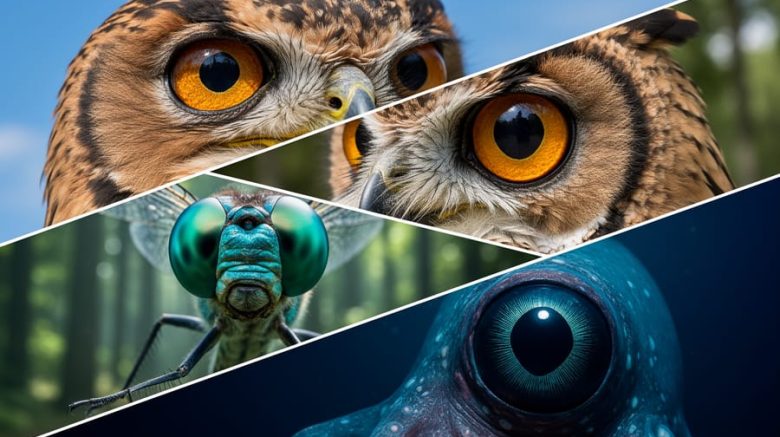
From the compound eyes of insects to the massive orbs of giant squids, the animal kingdom has evolved extraordinary ways to see the world. Each species has developed eye structures perfectly suited to their environment and survival needs.
Consider how a hawk spots prey from hundreds of feet in the air, while a nocturnal owl hunts in near-complete darkness. These remarkable abilities stem from specialized eye adaptations that far exceed human visual capabilities in specific ways. Understanding these diverse vision systems reveals not only the ingenuity of evolution but also helps us appreciate the complexity of our own eyes.
The animal kingdom showcases at least eight distinct eye types, each solving unique challenges. Dragonflies possess up to 30,000 individual lenses in their compound eyes, allowing 360-degree vision to catch flying prey. Deep-sea creatures have developed eyes sensitive enough to detect bioluminescent flashes in pitch-black waters. Chameleons can move each eye independently, scanning for both predators and food simultaneously.
These varied solutions to the challenge of sight demonstrate that there is no single perfect eye design. Instead, natural selection has crafted vision systems ranging from simple light-detecting cells to complex structures rivaling our most advanced cameras. By exploring different animal eyes, we gain insight into both the diversity of life and the precious gift of human vision we often take for granted.
Why Different Animal Eyes Evolved So Differently
The remarkable diversity of different animal eyes across the animal kingdom tells a powerful story of adaptation and survival. Over millions of years, different species developed vision systems perfectly suited to their unique environmental challenges and lifestyle needs. Understanding why these variations exist helps us appreciate the incredible flexibility of evolution and provides insights into how vision works across all living creatures.
Environmental pressures played a crucial role in shaping eye design. Deep-sea creatures, for instance, developed extremely large eyes to capture scarce light in dark ocean depths, while desert animals evolved specialized features to protect against sand and intense sunlight. Nocturnal hunters like owls gained tubular eyes packed with light-sensitive rod cells, enabling them to hunt effectively in near-total darkness. Meanwhile, daytime predators developed eyes optimized for tracking fast-moving prey in bright conditions.
Predator-prey relationships created an evolutionary arms race that dramatically influenced eye development. Predators needed sharp, forward-facing eyes for precise depth perception when hunting, while prey animals benefited from eyes positioned on the sides of their heads, providing nearly 360-degree vision to spot approaching danger. This constant pressure to either catch food or avoid becoming food drove remarkable innovations in visual capabilities.
Habitat requirements shaped specialized features we see today. Aquatic animals developed flat corneas to see clearly underwater, while birds of prey evolved exceptionally high visual acuity to spot small prey from great distances. Even the number of color receptors varies based on survival needs, with some birds seeing ultraviolet wavelengths invisible to humans, helping them find food and select mates. These adaptations remind us that vision isn’t one-size-fits-all but rather a customized tool refined by each species’ specific survival challenges.
Compound Eyes: The Multi-Lens Masterpiece
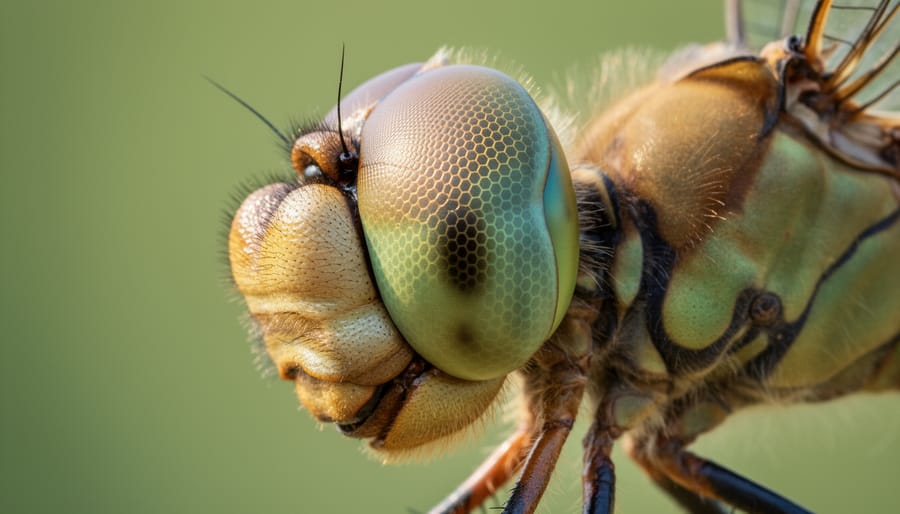
When exploring different animal eyes across nature, few structures are as remarkable as the compound eyes found in insects and crustaceans. Unlike our single-lens eyes, these sophisticated visual systems are composed of thousands of ommatidia, tiny individual visual units that work together like pixels on a screen to create a complete picture of the world.
Each ommatidium functions as its own miniature eye, containing a lens, light-sensitive cells, and supporting structures. A dragonfly, for instance, can have up to 30,000 of these units in a single eye, creating a dome-shaped surface that provides an incredibly wide field of view. This design allows insects to see in nearly all directions simultaneously without moving their heads, an advantage we humans don’t possess with our forward-facing eyes.
The real superpower of compound eyes lies in motion detection. Because each ommatidium captures a slightly different angle of view, any movement across the visual field triggers changes in multiple units almost instantly. This explains why it’s so difficult to swat a fly – these insects can detect your hand’s approach and react in milliseconds, far faster than animals with camera-type eyes can process similar threats.
Understanding how different animal eyes function helps us appreciate the diversity of vision in nature. While compound eyes sacrifice the sharp detail and color perception that our eyes provide, they excel at detecting movement and navigating through complex environments at high speeds. Bees use their compound eyes to spot flowers while flying, process polarized light for navigation, and even communicate through visual dance patterns with remarkable precision.
The mosaic image created by compound eyes differs significantly from what we experience. Rather than a single clear picture, insects likely perceive a grainy, pixelated view that updates incredibly quickly. This trade-off between image quality and processing speed represents an evolutionary solution perfectly suited to the fast-paced lives of flying and crawling creatures.
For anyone interested in maintaining their own eye health, studying these natural adaptations reminds us that vision comes in many forms, each optimized for specific needs and lifestyles.
Predator Eyes: Forward-Facing Vision for the Hunt
Among different animal eyes found in nature, predators have evolved some of the most specialized visual systems. Forward-facing eyes represent a crucial adaptation that distinguishes hunters from their prey, providing the precise depth perception needed to calculate distances when pursuing a meal.
Unlike herbivores that position eyes on the sides of their heads for panoramic awareness of approaching danger, carnivores sacrifice peripheral vision for something more valuable: binocular vision. When both eyes face forward, their visual fields overlap significantly, allowing the brain to merge two slightly different images into one three-dimensional view. This overlap is what enables a cat to judge exactly when to pounce or an eagle to time its strike with remarkable accuracy.
| Predator Type | Pupil Shape | Night Vision Capability | Binocular Overlap |
|---|---|---|---|
| Domestic Cats | Vertical slits | Excellent (6x better than humans) | 140 degrees |
| Owls | Large circular pupils | Superior (100x better than humans) | 70 degrees |
| Eagles | Round pupils | Moderate | 50 degrees |
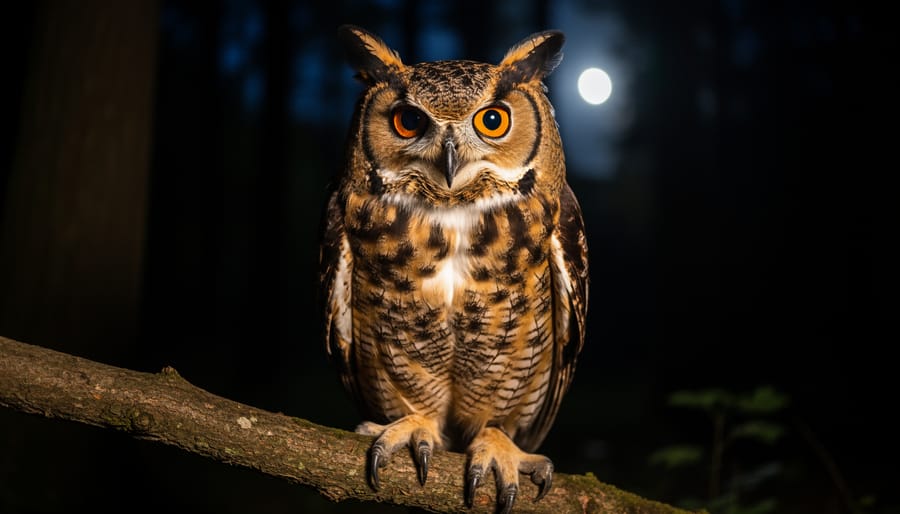
The eyes of predators also feature remarkable low-light capabilities. Cats possess a reflective layer behind the retina called the tapetum lucidum, which acts like a mirror to bounce light back through photoreceptor cells a second time. This biological enhancement explains the eerie glow you see when car headlights catch a cat’s eyes at night. Owls take nocturnal hunting even further with tubular-shaped eyes packed with rod cells, the photoreceptors responsible for detecting light in dim conditions.
Birds of prey like eagles and hawks prioritize sharpness over night vision. Their eyes contain a higher concentration of cone cells and a specialized area called the fovea with incredibly dense photoreceptors. This gives them visual acuity approximately eight times sharper than human vision, allowing them to spot a rabbit from two miles away while soaring overhead.
Understanding how different animal eyes have adapted to hunting challenges helps us appreciate the remarkable diversity of vision throughout the animal kingdom and reminds us that seeing clearly means something entirely different depending on whether you are predator or prey.
Prey Eyes: Panoramic Protection Systems
In the ongoing competition between predator and prey, different animal eyes have evolved remarkable specializations for survival. Prey animals like horses, rabbits, and deer possess one of nature’s most effective defense mechanisms: laterally positioned eyes that act as biological surveillance systems.
Unlike predators whose forward-facing eyes prioritize depth perception for hunting, prey species have eyes positioned on the sides of their heads. This strategic placement provides an exceptionally wide field of view, often approaching 360 degrees. Horses, for example, can see nearly all the way around their bodies with only small blind spots directly in front of their noses and directly behind them. This panoramic protection system allows them to detect approaching threats from almost any direction while grazing.
Rabbits demonstrate perhaps the most impressive wide-angle vision among mammals. Their bulging, laterally placed eyes give them a visual field of approximately 360 degrees, enabling them to spot predators from above, below, and behind simultaneously. This adaptation comes with a trade-off, however. The extensive peripheral coverage means rabbits have limited binocular vision directly in front, resulting in reduced depth perception compared to predators.
Deer similarly rely on their side-mounted eyes to remain vigilant in open environments. Their eyes are positioned high on their heads, providing excellent coverage of the horizon where predators typically approach. When a deer lowers its head to graze, the eye placement ensures continuous scanning of the surrounding area without requiring frequent head movements that might draw attention.
This panoramic vision system represents an evolutionary solution perfectly matched to the challenges prey animals face. While humans and other primates benefit from forward-facing eyes that enhance our ability to judge distances and navigate complex environments, prey species prioritize early threat detection. Understanding these adaptations in different animal eyes helps us appreciate how vision systems evolve to meet specific survival needs across the animal kingdom.
Underwater Eyes: Seeing Through the Depths
The underwater world presents unique challenges for vision that have shaped how aquatic animals see. Water absorbs light differently than air, scatters images, and creates optical distortions that land-dwelling creatures never encounter. Understanding how fish, octopuses, and deep-sea dwellers adapted their eyes reveals remarkable solutions to seeing in aquatic environments.
Fish eyes have developed spherical lenses to compensate for the way water bends light. Unlike the flattened lenses in human eyes, these perfectly round structures provide the extra focusing power needed underwater. Since water and the eye’s internal fluids have similar densities, fish rely almost entirely on their hard, spherical lenses to create clear images. This design works so effectively that many fish species can see quite well in their watery habitats, though they typically cannot adjust their focus by changing lens shape as we do. Instead, fish move their entire lens forward or backward, similar to how a camera focuses.
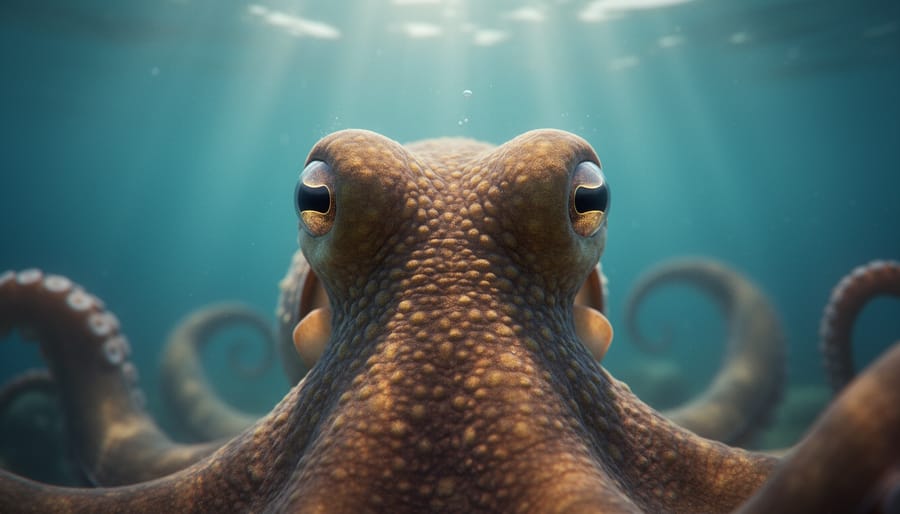
Octopuses possess surprisingly sophisticated eyes that evolved completely independently from vertebrate eyes, yet arrived at remarkably similar solutions. Their camera-like eyes include a lens, iris, and retina, but with some clever differences. Octopuses focus by moving their lens in and out, and unlike humans, they don’t have a blind spot because their retinal nerve fibers are organized differently. This gives them continuous, uninterrupted vision across their entire visual field.
Deep-sea creatures face perhaps the greatest visual challenge among different animal eyes: near-total darkness. Many have evolved enormous eyes relative to their body size to capture every available photon of light. The giant squid, for instance, has eyes the size of dinner plates, the largest in the animal kingdom. Other deep-sea fish have developed tubular eyes that point upward, helping them spot prey silhouetted against the faint light filtering from above. Some species have even evolved eyes with two separate retinas, one for seeing dim overhead light and another for detecting bioluminescent flashes from other creatures.
These aquatic adaptations remind us that vision isn’t one-size-fits-all. Each environment demands specific solutions, and nature has provided an incredible diversity of answers to the challenge of seeing clearly.
Night Vision Specialists: Eyes Built for Darkness
When exploring different animal eyes, nocturnal species reveal some of nature’s most impressive adaptations for seeing in darkness. These nighttime hunters and foragers possess specialized eye structures that allow them to navigate, hunt, and survive in conditions where human vision would fail completely.
The tapetum lucidum stands out as one of the most remarkable features in nocturnal animal eyes. This reflective layer sits behind the retina, acting like a mirror that bounces light back through the light-sensitive cells a second time. Think of it as giving photons a second chance to be detected. This recycling of light significantly amplifies visual signals in low-light conditions, making nocturnal animals far more efficient at capturing whatever dim light is available.
The reflected light appears in different colors across species—green in cats, blue in dogs, and red in some rodents—depending on the specific minerals and structure of their tapetum lucidum.
Beyond this reflective layer, nocturnal animals feature dramatically enlarged pupils that open wider than those of daytime creatures. These larger openings allow maximum light entry, similar to how a camera lens opens to capture photos in dim settings. Cats, for instance, can dilate their pupils to cover nearly their entire eye surface.
The internal composition of these eyes differs significantly from human eyes as well. Nocturnal species pack their retinas with rod cells—the photoreceptors responsible for detecting light and motion rather than color. While humans have roughly 120 million rods, some owl species possess up to five times this concentration, enabling them to detect prey movement in near-complete darkness.
This abundance of rods comes with a trade-off: reduced color vision. Most nocturnal animals see primarily in grayscale, prioritizing light sensitivity over color detection—a practical exchange when hunting at night.
The Mantis Shrimp’s Superpower Eyes
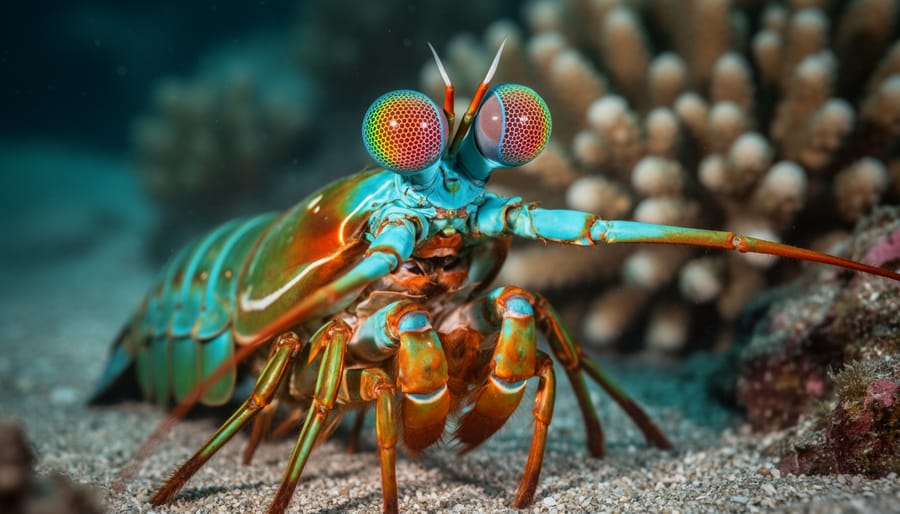
Among the different animal eyes found in nature, the mantis shrimp possesses perhaps the most extraordinary visual system on Earth. While humans have three types of color receptors in their eyes, these remarkable crustaceans boast an incredible 12 to 16 types, depending on the species. This gives them the ability to perceive a spectrum of colors far beyond our comprehension.
What makes mantis shrimp eyes truly unique is their ability to detect polarized light in ways no other animal can match. Each eye moves independently and contains three distinct regions, essentially giving the mantis shrimp trinocular vision in each eye. This means they can gauge depth and distance with a single eye, something humans need two eyes to accomplish.
These complex eyes can also see ultraviolet light, which is invisible to us. Scientists have discovered that mantis shrimp use UV patterns to communicate with each other and identify potential mates. Their polarized light detection helps them navigate through murky waters and spot transparent prey that would otherwise be nearly invisible.
The structure of mantis shrimp eyes differs dramatically from human eyes. Rather than a simple lens and retina arrangement, their eyes contain specialized rows of photoreceptors stacked in layers. Each layer processes different types of light information, from color to polarization to brightness.
Interestingly, despite having more color receptors than any known creature, recent research suggests mantis shrimp may not distinguish colors as precisely as we do. Instead, their numerous receptors allow them to process visual information much faster, giving them split-second advantages when hunting or avoiding predators. This discovery reminds us that more complex doesn’t always mean better, just uniquely adapted to specific survival needs.
What Human Eye Health Can Learn From Animal Eyes
Studying different animal eyes has opened remarkable doors for human vision care and medical innovation. Scientists and researchers continue discovering how the unique adaptations found across the animal kingdom can help us better understand, protect, and treat human vision.
The exceptional night vision of cats and owls, for instance, has taught researchers valuable lessons about retinal structure and light sensitivity. This knowledge has contributed to developing better treatments for conditions like night blindness and age-related macular degeneration. By understanding how these animals maximize available light through specialized cells and reflective layers behind their retinas, medical professionals can explore new approaches to enhancing human low-light vision capabilities.
Marine animals with different eyes have proven particularly valuable for research. The compound eyes of mantis shrimp, which can detect polarized light and an extraordinary range of colors, have inspired breakthroughs in early cancer detection technology. Scientists have created imaging devices based on these principles that can identify abnormal tissue more effectively than traditional methods.
The practical applications of animal eye research extend into multiple areas of everyday technology and medical care:
- Camera sensors and smartphone cameras modeled after insect compound eyes for wider viewing angles
- Improved laser eye surgery techniques inspired by the self-healing properties found in fish corneas
- Anti-reflective and scratch-resistant coatings for eyeglasses based on moth eye structures
- Advanced protective eyewear for athletes and workers incorporating design elements from predatory bird eyes
- Artificial retina development using insights from eagle and hawk visual processing
These innovations demonstrate how studying vision across different animal eyes directly benefits human eye health. Even simple observations about how certain species avoid eye diseases or maintain clear vision throughout their lifespans provide valuable clues for preventing age-related vision problems in humans. This cross-species research continues to reveal new possibilities for protecting and improving our sight.
The incredible diversity of animal eyes across species reveals nature’s remarkable ability to solve vision challenges in countless creative ways. From the compound eyes of insects that detect rapid movement to the light-sensitive organs of deep-sea creatures adapted for near-total darkness, each eye type represents millions of years of evolutionary refinement tailored to specific environmental needs and survival requirements.
Understanding these variations helps us appreciate the complexity of vision itself. While mantis shrimp can perceive ultraviolet and polarized light beyond our comprehension, and eagles can spot prey from extraordinary distances, humans possess our own unique visual strengths, including exceptional color discrimination and detail recognition. This comparative perspective reminds us that no single eye design is universally superior—each serves its owner’s lifestyle perfectly.
Exploring different animal eyes also highlights the importance of protecting and maintaining our own visual health. Just as various species depend entirely on their specialized sight for survival, we rely heavily on our eyes for daily function, safety, and quality of life. Regular eye examinations, protective eyewear when needed, and awareness of changes in vision become even more meaningful when we recognize how precious and irreplaceable our sight truly is.
Whether you’re fascinated by the biological diversity in nature or focused on caring for your own eyes, remember that vision represents one of evolution’s most extraordinary achievements. By staying informed about eye health and seeking expert advice when concerns arise, we honor the remarkable gift of sight that connects us to the visual world around us.