
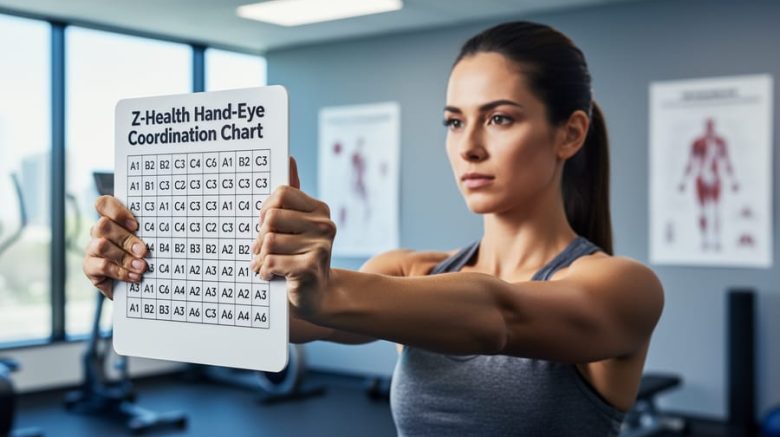
The Z-Health hand eye coordination chart is a vision training tool that uses smooth pursuit eye movements across a grid of letters and numbers to improve how your eyes track moving targets and coordinate with physical movement. Developed as part of the Z-Health Performance Solutions system, this chart trains your visual system through structured tracking exercises that challenge both your eye muscles and the neural pathways connecting vision to motor control.
Unlike static vision charts you might encounter at a routine eye exam, this tool requires active movement. You hold the chart at arm’s length and slowly move it in patterns (circles, figure-eights, horizontal sweeps) while keeping your eyes locked on a specific letter or number. The exercise sounds simple, but it demands precise coordination between your eye movements, head stability, and often simultaneous physical tasks like balancing on one foot.
The chart works by training smooth pursuit, one of the six types of eye movements your visual system relies on daily. When smooth pursuit function declines (whether from aging, neurological conditions, or simply lack of training), you might notice difficulty following moving objects, reading while in motion, or coordinating hand movements with what you see. These challenges affect everything from athletic performance to driving safety, making them important vision health indicators worth monitoring.
For many users, the primary question isn’t what the chart does but whether it belongs in their vision training routine. The answer depends on your specific goals, current visual capabilities, and whether you’re working under professional guidance or exploring self-directed vision training options.
What Is the Z Health Hand-Eye Coordination Chart?
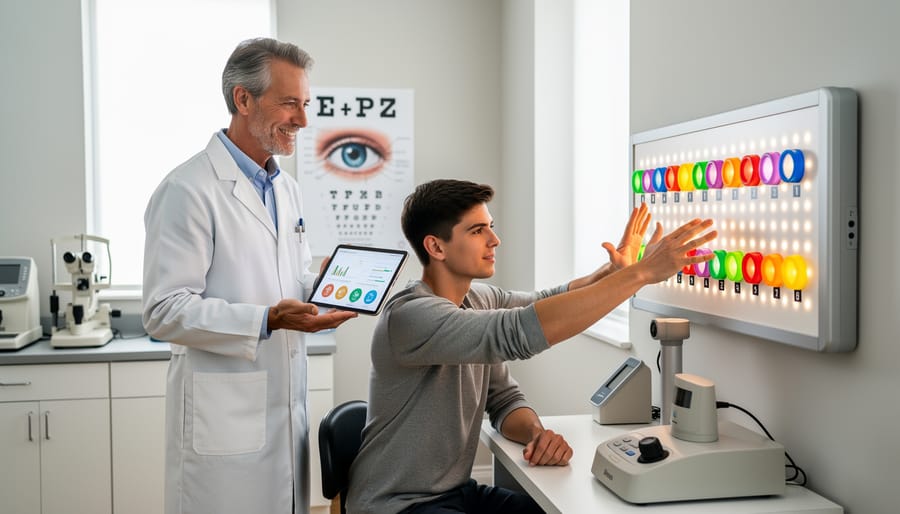
The Z Health hand-eye coordination chart is a specialized visual training tool developed within the framework of neurocentric training, an approach that views movement, vision, and performance through the lens of brain-based function rather than isolated physical skills. Created by Dr. Eric Cobb and the Z Health Performance team, this chart emerged from the understanding that vision is primarily a neurological process: your eyes capture light, but your brain interprets what you see and coordinates the motor responses that follow.
Unlike standard eye charts that measure static visual acuity (how clearly you see letters at a distance), the Z Health chart focuses on dynamic visual-motor integration. It doesn’t just test whether you can see clearly; it assesses how efficiently your visual system and motor system work together during movement. The chart typically features multiple visual elements including color-coded targets, numbered tracking points, geometric patterns, and directional cues arranged in specific spatial relationships. These elements are designed to challenge different aspects of visual processing simultaneously, peripheral awareness, central focus, tracking speed, and convergence ability.
The design philosophy differs fundamentally from both traditional optometric charts and even comparative biological tools like an animal eye diagram which illustrates anatomical structures rather than functional performance. During typical use, you perform specific movement patterns while maintaining visual focus on designated targets, forcing your nervous system to integrate visual input with motor output under controlled conditions. This neurological challenge is what drives improvement in hand-eye coordination and broader visual function.
How Hand-Eye Coordination Relates to Vision Health

Hand-eye coordination isn’t just about catching a ball or threading a needle. It represents the seamless integration of your visual system with motor control, and deterioration in this integration often signals underlying vision problems before they become obvious in daily life.
When your eyes track a moving object, multiple visual subsystems must work in concert. Your tracking ability reflects how smoothly your eye muscles follow motion, while convergence measures how well both eyes work together to maintain single, clear vision at varying distances. Poor tracking often manifests as skipping lines while reading or losing your place in documents. Inadequate convergence creates double vision or eyestrain during close work, symptoms that many people dismiss as mere fatigue rather than recognizing them as measurable vision deficits.
Peripheral awareness connects directly to overall visual field health. Your ability to detect and respond to movement at the edges of vision depends on both retinal function and neural processing speed. When hand-eye tasks requiring peripheral input become noticeably harder, it may indicate problems ranging from simple refractive errors requiring vision correction to more serious conditions affecting peripheral vision.
Reaction time represents the speed at which your brain processes visual information and translates it into physical response. This metric ties vision health to fall risk in older adults, driving safety across all ages, and performance in activities requiring quick visual decisions. Slower-than-expected reaction times in hand-eye tasks frequently indicate processing delays that standard vision tests miss entirely.
These metrics matter because they predict real-world function. Someone with 20/20 visual acuity might still struggle with daily tasks if their tracking, convergence, peripheral awareness, or reaction time is compromised. The Z Health approach recognizes that vision health extends far beyond reading letters on a wall chart.
How the Z Health Chart Works
Common Exercises and Protocols
Z Health’s chart-based protocols typically progress from simple to complex movements. Begin with smooth pursuits: hold the chart at arm’s length and trace a single target (like a letter or dot) in slow horizontal lines from left to right, keeping your head still while your eyes follow. Move to vertical tracking, then diagonal patterns, gradually increasing speed as accuracy improves.
Convergence drills use dual targets on the chart. Focus on two points simultaneously while slowly bringing the chart toward your nose, maintaining clear single vision of both targets. When the image doubles, pause, then move the chart away until fusion returns. Repeat 10-15 times, noting the distance at which doubling occurs, this “break point” should gradually move closer with practice.
For peripheral awarenessfixate on a central target while identifying letters or symbols in your peripheral field without moving your eyes. The chart’s layout, with targets arranged at varying distances from center, trains the wide-field processing that some animal eyes possess naturally but humans must consciously develop.
Saccade training involves rapidly jumping between two marked points, holding each fixation for one second. Start with targets spaced closely, then increase separation. Combine movements: horizontal saccades followed immediately by vertical tracking challenges your visual system’s ability to switch between movement types, essential for sports and driving.
What Your Performance Reveals
Your performance on Z Health hand-eye coordination exercises provides valuable insights into your visual system’s efficiency. If you find certain tracking patterns difficult or experience eye strain during specific movements, this often signals weaknesses in particular eye muscle groups or coordination pathways.
Smooth, controlled eye movements during tracking exercises indicate good oculomotor control. Conversely, jerky or hesitant movements suggest your eyes are compensating rather than tracking efficiently. This compensation pattern frequently appears in people who’ve adapted to minor visual processing issues without realizing it.
Difficulty maintaining focus during convergence drills points to potential issues with the muscles controlling inward eye movement. Many people discover they’ve been unconsciously avoiding tasks that require sustained near focus, like reading, because their convergence system wasn’t functioning optimally.
Performance asymmetries between left and right visual fields can reveal imbalances in how your brain processes information from each eye. These patterns aren’t vision problems in the traditional sense, your prescription might be perfect, but they indicate opportunities to strengthen the neurological pathways connecting your eyes to movement planning and execution.
Fatigue patterns matter too. Rapid deterioration in accuracy suggests your visual system lacks the endurance needed for sustained performance.
Who Benefits from Z Health Hand-Eye Coordination Training?
Z Health hand-eye coordination training serves diverse groups facing different visual-motor challenges. While originally developed for athletic performance enhancement, the approach has proven valuable across age groups and conditions affecting visual processing.
Athletes represent a primary beneficiary group. Sports requiring rapid visual tracking, tennis, baseball, hockey, basketball, demand precise eye-hand timing that Z Health exercises specifically target. By training the neurological pathways connecting visual input to motor response, athletes often see measurable improvements in reaction speed and spatial judgment.
Older adults experiencing age-related vision changes find particular value in this training. Natural declines in contrast sensitivity, peripheral awareness, and tracking speed can affect driving safety and fall risk. Regular practice with the chart helps maintain visual-motor integration that supports independence and daily function.
| User Group | Typical Challenges | How Training Helps |
|---|---|---|
| Athletes | Reaction delays, spatial misjudgment | Sharpens visual tracking and anticipation |
| Aging Adults | Reduced peripheral awareness, slower processing | Maintains visual-motor pathways, supports safety |
| Concussion Recovery | Visual fatigue, tracking difficulties, dizziness | Rebuilds neurological connections gradually |
| Children with DCD | Poor coordination, difficulty catching/throwing | Develops foundational visual-motor skills |
People recovering from concussion, stroke, or brain injury often experience disrupted visual processing that affects balance and coordination. The structured, progressive nature of Z Health exercises allows controlled rehabilitation of these neurological pathways without overwhelming the recovering nervous system.
Children diagnosed with developmental coordination disorder (DCD) or showing delays in hand-eye skills may benefit from supervised Z Health training as part of a comprehensive therapy approach. The visual tracking and targeting exercises can help establish foundational visual-motor patterns that support academic and physical activities.
What to Expect: Getting Started with Z Health Vision Training
Starting Z Health vision training is straightforward, though your approach depends on your goals and current visual function. The basic hand-eye coordination chart exercises can be practiced independently at home with minimal equipment, many practitioners share foundational drills through online videos and downloadable charts. However, if you’re addressing specific vision deficits, recovering from injury, or experiencing persistent visual symptoms, working with a Z Health certified practitioner ensures proper assessment and progression.
Most people begin with 5-10 minute sessions, three to four times weekly. This frequency allows your nervous system to adapt without overwhelming it. You’re training neurological pathways, not just eye muscles, so quality matters more than duration. Starting too aggressively often leads to eye strain or headaches.
Initial improvements typically appear within two to three weeks of consistent practice. You might notice easier tracking when reading, better depth perception while driving, or reduced eye fatigue during screen time. More complex visual-motor integration improvements, like athletic reaction time or reading speed, generally develop over two to three months.
Track your baseline performance before beginning. Record how quickly you complete specific tracking patterns, note any areas where you lose focus, and document symptoms like headaches or blurred vision. This record provides objective feedback as you progress and helps identify which exercises deliver the most benefit for your particular visual challenges.
Frequently Asked Questions
Where can I find the Z Health hand-eye coordination chart?
The official Z Health charts are available through certified Z Health practitioners and the Z Health Performance website. Many practitioners also create simplified versions for home practice after initial professional assessment.
How long should I practice with the chart each day?
Most protocols recommend 5-10 minutes of focused practice, once or twice daily. Quality of movement and attention matters more than duration, so shorter sessions with full concentration typically produce better results than longer, fatigued practice.
Can I use the Z Health chart alongside other vision therapy exercises?
Yes, the chart integrates well with traditional vision therapy, as it targets the neurological component of visual processing rather than eye muscle strength alone. Coordinate with your vision therapist to ensure exercises complement rather than duplicate each other.
Is there scientific evidence supporting this approach?
The chart draws on established neurological principles of motor learning and visual processing, though large-scale studies specific to the Z Health chart remain limited. The broader evidence base for visual-motor training and neuroplasticity supports the underlying mechanisms.
Cost varies depending on whether you work with a certified practitioner or purchase materials for self-guided practice. Initial professional assessments typically range from standard consultation fees, while chart materials themselves are relatively inexpensive. The real investment is time and consistent practice rather than equipment expense.
For those concerned about accessibility, basic tracking and convergence exercises can be performed with minimal equipment. A simple printed target or even household objects can substitute for the official chart when cost is a barrier, though professional guidance helps ensure proper technique and progression. The principles remain the same regardless of whether you use branded materials or adapted alternatives.